
The MAKING PEDs Digital Twin Platform has received the highest innovation score among 44 innovations from the Driving Urban Transitions (DUT) Call 2022, marking a significant milestone for the European project and its work on Positive Energy Districts.
Coordinated by the Catalonia Institute for Energy Research (IREC), MAKING PEDs spent two and a half years developing digital tools and methodologies to help cities plan Positive Energy Districts (PEDs) and accelerate their transition towards climate neutrality.
PEDs are urban neighbourhoods designed to produce more renewable energy than they consume. Planning them requires cities to consider a wide range of interconnected factors, from building energy performance and embodied emissions to mobility, water, waste, renewable energy, and nature-based solutions.
A Digital Twin Platform to Support Urban Planning
At the heart of MAKING PEDs is its Digital Twin Platform, a decision-support tool that brings together 3D city models, urban data, and sustainability assessment modules. It enables cities to simulate scenarios, evaluate potential interventions and explore different approaches to urban district regeneration, including building retrofits.
By bringing these elements together in an interactive environment, the platform supports a more integrated approach to planning and assessing Positive Energy Districts.
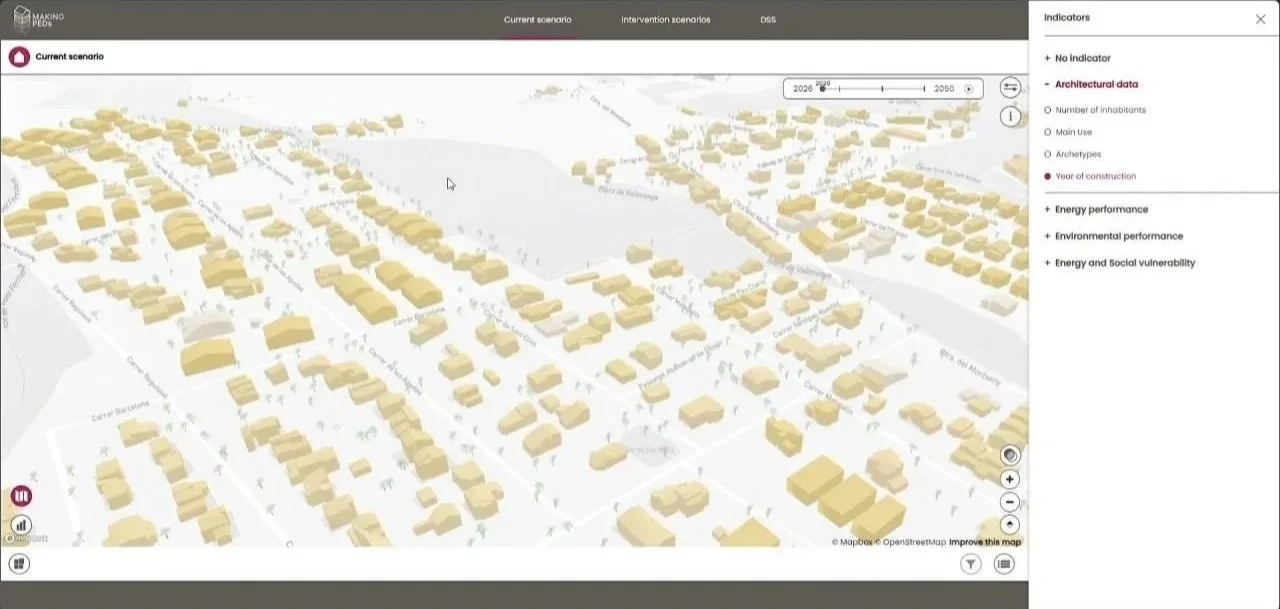
The MAKING PEDs Digital Twin Platform brings together 3D city models, urban data and sustainability assessment tools to support the planning of Positive Energy Districts.
European Recognition for the Project’s Innovation
Beyond its recognition as the highest-scoring innovation in the DUT Call 2022, the platform has also been featured in the DUT Partnership’s innovation portfolio showcase.
The recognition has also brought opportunities to bring the project’s work to wider audiences. On 6 October, the MAKING PEDs team gave an online presentation to participants attending the DUT City Panel in Hungary. On 22 October, Jaume Salom, Head of IREC’s REACT Department and MAKING PEDs project coordinator, presented the project as a success story at the DUT Call 2022 Online Final Event.
The platform was also selected as a finalist in the Sustainability category of the eAward 2026 and the Llavor category of the EmErgEnt Awards 2026.
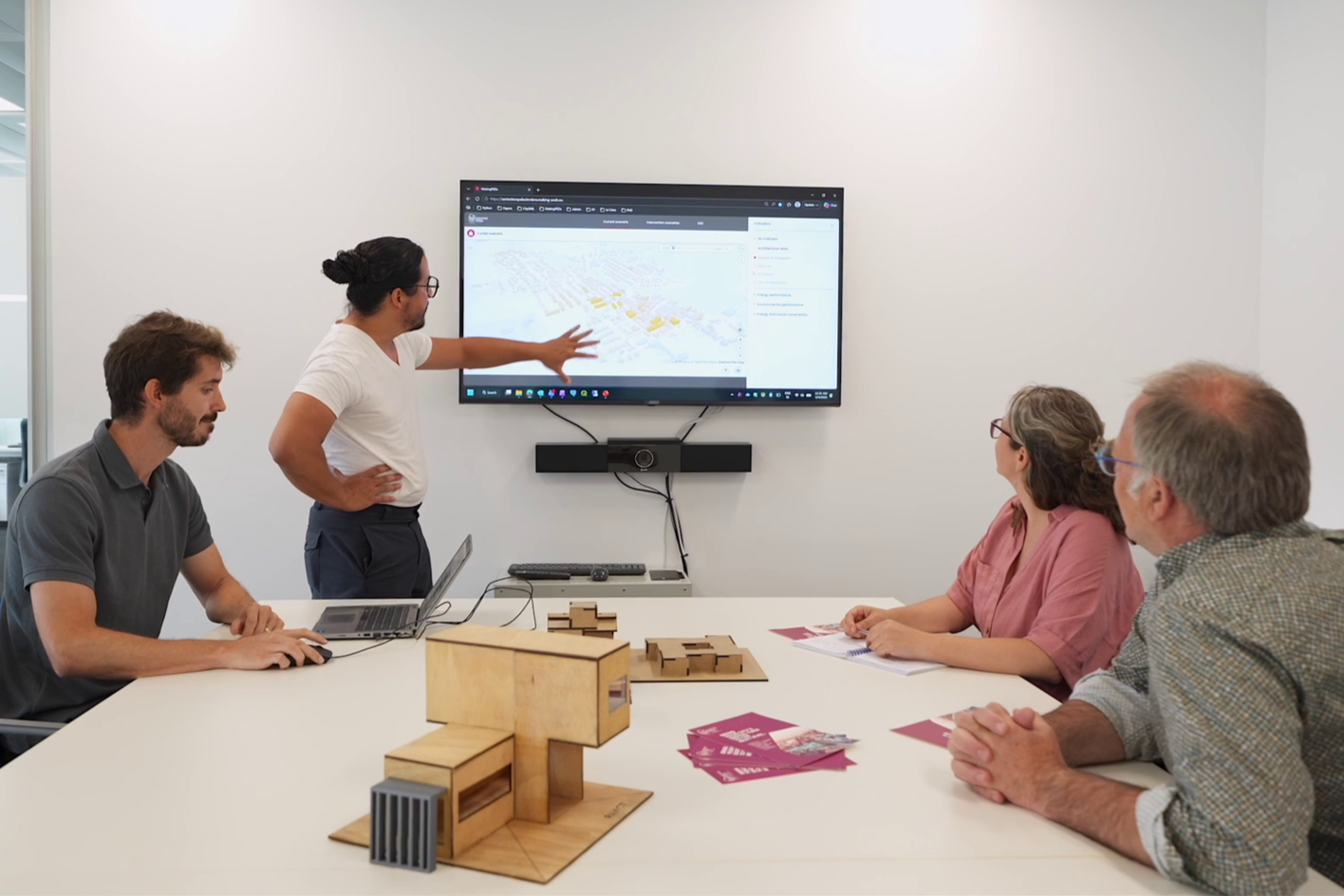
The MAKING PEDs platform was one of three finalists for the Premi EmErgEnt 2026. (Photo credit: IREC)
Beyond the Platform
MAKING PEDs has delivered other tools and methodologies to support PED development. These include workflows for creating 3D city models, led by the Norwegian University of Science and Technology (NTNU), and a methodology for stakeholder engagement in PED planning, developed by the Austrian Institute of Technology (AIT).
The project brought together research organizations, universities, public authorities and companies from across Europe. Its work was connected to four pilot districts in Linz, Austria; Civitavecchia-Rome, Italy; Sant Esteve de Palautordera, Spain; and Bærum, Norway. Learn more about the consortium and the project.
Continuing the Work Through Scale-Up MAKING PEDs
Although MAKING PEDs has concluded, its work continues through Scale-Up MAKING PEDs. The follow-up project builds on the results to bring these innovations closer to implementation and explore their application at both neighbourhood and city scale, with further work on interoperability, replicability and scalability.
Explore the Digital Twin Platform and watch the video to see it in action: